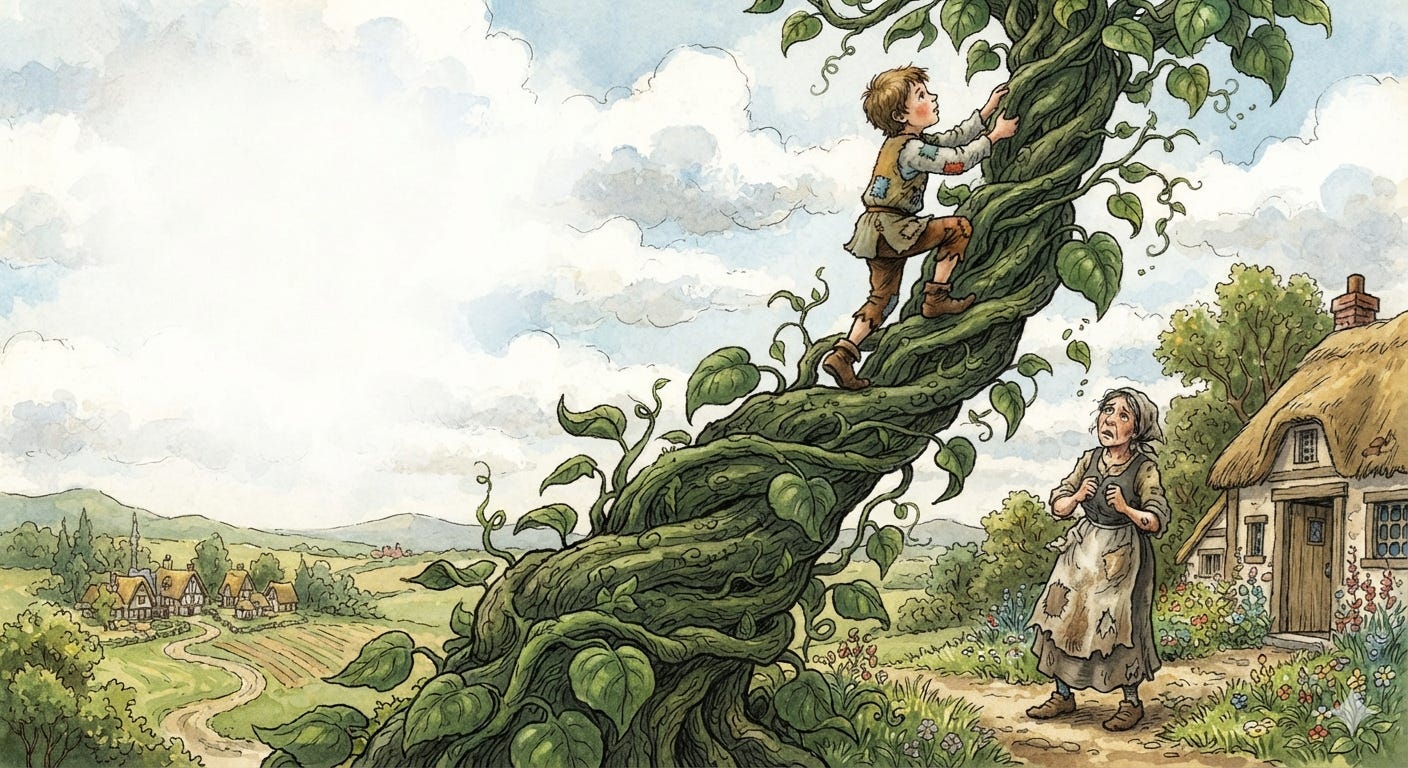
	This fourth avatar of my Personal Poetics became too long for me to comfortably POST, something like the magic beans fairytale Jack accepted in exchange for his mother’s cow which she threw from their door (in a daze of enraged dismay), but then sprung overnight into the enormous beanstalk of braided vines Jack climbed  to discover a peculiarly symbolic and dialectical array of riches, a singing harp, a hen which lay golden eggs (I've always preferred to think goose), and dangers of the FEE, FI, FO FUM variety, embodied in a horrid, gigantic Ogre. Jack survived the giant Ogre  by hiding in the oven of the Ogre’s pitiful little wife, who was thrilled by Jack’s visit and hoped he’d come again.
        Something analogous occurred with my Personal Poetics #4, but not overnight. More like the thick, dreadfully self-entangled beanstalk of a month. Yet eventually, here will appear, blending explication and foggy memoir, four poems I struggled to understand, a struggle that nonetheless helped me find the appropriate voice for writing my recently posted poems. These will be, as always, and as they must,  personal readings, offered perhaps to honor the spirit of both Jack and the Ogre of the beanstalk’s salvational, if not precisely compliant little wife.

        *
        Poems consist of words surrounded by space that signals the mind to read as if intoning a voice—Borges described this eloquently words sensibly and seductively impressing themselves upon their reader's  innocent, acquiescent tongue, an ideal  doubling and duplicity's splicing of individual coherences and selves, poet's and reader's. Words in prose tend to be descriptive and  indicative, whether abstract or objective and specific: nuanced and insinuating, vibrant and even dancing, but are continuous in space, go on and on, but refer steadily, no matter how they dance, prance or insinuate, adorn, enhance, and vivify, and generally, are more concerned with reality’s possibilities, not the plaintive chaos of voice and drama of the psyche and self’s aspirations. Insisting on interpretive perfection's a lost cause. Besides being unattainable, understanding is a river none can enter twice. It evolves, changes, and seasonally freezes. It’s virtually non-existent, in its way, as a dead star: whatever enters its gap vanishes with an occult gulp, and is permanently unredeemable. It's an ingloriously alluring vacuity  to which nothing can be added to improve it.
	I don’t know, I guess, and think I’m grappling with an unintelligible abyss. Maybe it’s a matter of primacy, poems more self-referential than objective, prose less, or as I prefer to claim, personal, and reflect on how I read and how I taught myself, about 4 years old, a miserable little bastard back when when refused to eat what I was fed and  became skinnier and skinnier. The exasperated woman—there was no Ogre around, not even in rumour, except me, and I a Hansel imprisoned by a witch with no beloved sister Gretel, in this a farmhouse with falling plaster, in the forest but not plastered with marzipane with candycane railings, who gave her a bone when she came to fondle his leg and see if fit to gobble, c'est mois—who owned and ran this long-ago failed pig-farm in Egypt, New Hampshire, with a clientele of foster-care and reform school kids, or the wretched offspring of single Moms like mine who couldn’t afford anything better, nominally sent to escape Boston’s summer heat and solve awhile the constant headache of childcare, so I withdrew, wrapped myself into myself, an unwholesome sulkb—so this frizzy-haired witch finally seized my face, squeezed my cheeks to force open my mouth, and and rammed a unique slobgullion of tuna and hard-boiled egg salad to ideally reach my gullet, but the bottom of the spoon made me gag, and I was crying, choking, and wriggling like mad, gathering an attentive host of horrified older kids, so her experiment failed like her pig-farm, and I was sent to bed to sob, calm and collect myself.
	 I had a friend, maybe 7 or 8, at Camp Failed Pigfarm, who’d been arrested several times for goosing women on the platforms of Boston subway stations, and the two of us, day after day, followed a gleaming set of railroad tracks which ran through the farm's sandy, undeveloped acreage, hoping we'd discover wild raspberry or blueberry thickets (we never did), or reach a town and meet bored girls our age (never did that either), or find a small store where with the quarter I’d received from a tooth fairy (presumably arranged by my mother in advance) purchase a candy I'd heard about, an all-day jawbreaker, black and bigger than a marble, and which assumed the colors of the rainbow and the specific fruit flavors they signified as you sucked and periodically plucked or spit it into your hand to see what was up with it—for though I refused to eat, I was always hungry as hell—and he (his name was Tom, of all things), with increasing reluctance, regaled me with his assaults on female dignity, which may have included stealing pocketbooks, as subways roared into a station—he could do this all day, get on different trains, off at different stations—but he found the details I sought distasteful or merely tedious, and balked at my urgent prodding. My curiosity mounted, eager and intense, my interest surely unpleasantly lascivious, and at last Tom clammed up.
        Our zest for adventure and each other faced an array of inhibitions, but mainly the  long railroad bridge we didn't want to recross in the dark to get back to the farmhouse for our  evening meal. I could eat mashed potatoes so on, familiar food. I think anorexia nervosa is a passive-aggressive refusal to ingest what isn't mother’s milk. This intensifies like the vacuity of a tornado until its whirl merges and overwhelms the psyche’s hysterical engines, taking on a deadly life of its own.  As for Tom, who made women squeak, dangerously bolt and stumble as they waited for the next train to roar into the station, was simply not as voluble as I was already—another curious of life's dynamics—and that I had exhausted him. I worry about that sort of thing, many years later.

            I feared the fury of my wind
            Would blight all flowers fair and true,
            But the sun it shined and shined
            And my wind it never blew.
                                        William Blake

        I also recall us finding, one day on our quests for berrry bushes, a tiny town with small stores likely to sell all-day jawbreakers, or bored girls who might find us exotic—
finding anyhow, stained red chewed stumps of maple saplings, half-chewed, half-felled by a beaver with a bloody tooth—maybe all beavers have bloody teeth—as well as  huge, smooth as tulip petals, beautiful, dark-red beautiful wood chips, ruby red as horse chestnuts. When I think of Edward Fitzgerald's translation of THE RUBAIYAT OF OMAR KHAYYAM—a book of verse, a jug of wine, and thou beside me—my head lurches like blood-red wine lurching in that jug, despite how ruba in Persian and Arabic is a poetic quatrain in poetry, and a rubaiyat is a collection of them.
	My Pigfarm Summer Camp had no programs which weren’t free-form, and one night, my bafflement at life acute as a bugbite, suddenly mindful of a particular story I pestered my Mom back home in our three rooms in Boston, near the foot of Beacon Hill, to read me again and again. It was in an illustrated children’s book, Russian Folk Tales for Children, which she’d stuffed in a suitcase with my clothes for the comfort of its illustrations, particularly a pair of childless peasants, the wife annoyed with her husband's propensity to swill too much kvass with his lunch, then stumble out to take  long naps in the imperfect, noonday shade of a grotesque apple tree, how his wife’s annoyance reached a peak relieved when noted a horsefly on her spouse's brow, and   managed to mash it with a handy watermelon so the fly wouldn’t disturb his slumber. The husband survived his astonishment with a lump, not the melon. I can still picture his wife, oblong watermelon high in both hands.
        I knew the alphabet, could spell out to myself the words on the page, infuse them with my mother’s voice, and relieve my misery. I soon discovered my eyes moving faster than my conscious, auditory mind to accommodate her voice's balm and fluctuating caresses, and in minutes I was reading. Thus meant I learned to read by internalizing sounds rather than by sight recognition, considered an inefficient, inferior method. I was certain somewhere Wallace Stevens wrote a line that went, The mother’s voice, the purpose of the poem,  but the Wallace Stevens Concordance said No. That was because Stevens wrote in his beautiful, “The Auroras of Autumn,” (p413, in THE COLLECTED POEMS),  the mother’s face,/The purpose of the poem, fills the room.’
        My mother loved to sing, was a mezzo-soprano. I drafted this on June 15th, adding that tomorrow would have been my mother’s 100th birthday, born on Bloomsday, 1916. When she sang (Molly Bloom also sang), I assume, her voice filled the room as Stevens’ didn’t say. I’m not trying to recall my mother, whose entire being fills my head, but to affirm how personal are these imperfect essays, just as anyone reading a poem to themselves demands an imperfect because personal investment of self that is sensible, coherent and intelligible. But this is not how literature is taught. Professors read and teach with nervous, defensive reverence, insist words require not a voice for coherence and intelligibility, but a mare’s nest of footnotes they've insalled in their heads as if for self-esteem's ballast. For years for me I couldn't read Joyce’s ULYSSES’ opening sentence. My bible of literary modernism's awesome reputation and the way I'd been taught blocked giving it intelligible comprehension. Each and every word had to be probed for a symbolic or literary significance:

	Stately, plump Buck Mulligan came from the stairhead, bearing a bowl of lather on which a mirror and a razor lay crossed.

	For years these words  shivered and slivered in my ardent but green mind, a garden snake, with teeth like curved translucent needles—Emily Dickinson’s narrow fellow in the grass, to which I may refer later, knowing me—but for years I couldn’t divine a spider’s thread that connected this to any personal authorial intent, nor could I enrich it by grasping the narrator’s bitter fury at Stately, plump Buck Mulligan, relatively well-heeled and shielded by his sophomoric theater of condescension and  complacently pompous mockery, pragmatic, bourgeois yuppy of an Irishman unstung by a motto such as Joyce’s, Per aspera ad astra! (By adversity to the stars!), which I think got him up there , all right, but may have driven him crazy, or is why left those of us who care with his black and khaki, exploding pineapple between the ears, FINNEGANS WAKE. But I literally couldn’t read and see pompous Buck Mulligan emerge from the stairhead to their squat—is it ever clear? I think there's mention of rent, so not a squat—and in the Martello Tower’s circle of crenels, and fatuously dramatize his shave. Joyce’s rage, I’d urge, was a gauntlet flung at him for us.

          *
        Poetry's metaphysical self-referentiality is intimidating. Raised in the era of New Criticism, which I immediately sensed took poetry from away from the intentions of poets and gave it to academics. Despite the occasional assurance that  a lyric poem is the cry of its occasion, rhetorical intention is barred, reader intuition bridled by the so-called intentional fallacy and by writing workshops’ call for concrete imagery, an absurd oxymoron worthy of Buck Mulligan. Stevens heretically affirms at the outset of his “Notes on a Supreme Fiction,” a poem the equivalent of a novella, that It must be abstract! For me this was confusing, though after a very long while, I realized it was what I taught Composition students, the paragraph's opening sentence could organize and govern what came next for the reader, as a topic sentence. In a poem, topic needn’t be uttered, but it must exist. Amalgam's a good word for the tangle of thought and feeling's paradoxes, contradictions, ambiguities, shame, secretiveness and suffering, that guides, instructs, shapes and commands poetic utterance's obedience. Begin ephebe, writes Stevens at  the outset of his Notes. What the hell is an ephebe? Is he calling us feeble-minded, yes and no, but the way this long difficult poem evolves, he's hogging the fun of doing so all for himself. Or is he talking to himself, just as I'm going to claim when discuss "Earthy Anecedote," first poem in his first book and forever after, that the firecat is Wallace Stevens.
         So a mentally grasped, evolving abstract intent, comprehensive internal contradictions, (It must change!) which braid feeling, drama and delight (It must give pleasure!), like Jack's Magic Beanstalk: concise surprise, intelligent respect, even  reasonably pasteurized hysteria. Let’s get on with it. I want to call "Earthy Anecdote" l a modernist Fabliau, which was a low, comic, popular poetic format in Medieval France, Stevens a Francophone in adulthood, must begin with a discussion of VOICE, that unstable complexity people are always finding and defending, often as something healing when found, also something unstable and impermanent, complex as that symbol of medicinal authority, the Caduceus, Hermes of Mercury's headless staff crowned with immense and spread, alabaster wings, twined with serpents holding out forked tongues at each other, enabling those gods to fly and deliver divine messages as fast as I learned how to read. Like Jack’s beanstalk, voice is twined with elephant-ear vines, reaches the clouds and the Ogre’s kindly wife.
	I think the voice poets describe themselves as seeking is one that's adequate to many differing combinations of personal needs. There’s a need to meet the adequacy to the emotional chaos of selfhood, the business models of literary gatekeepers, the expectations of one’s community, whether of gender, politics, ethnicity, race and victimhood, the suffering of the meek who seek to the comfort of each other, the recognition, sympathy and approval of the strong, and the hope of inheriting the  earth, the deformed, defiant rage of outsiders, the crazed and resentful.
        In this regard it’s important to bear in mind that we speak in different voices to our various social and entirely personal connections, parents, pals, lovers, girlfriends and boyfriends, employers, enemies, neighbors, strangers to whom we strive to be polite. I think of myself as being highly distrustful of gatekeepers, whose ambitions have corrupted the little intelligence they ever possessed and whose preening anxieties, easily excited by perceived violations of ironclad pieties, get expressed in condescension, dishonesty, stupidity, and the fraught rejection of the likes of me, but I wouldn’t mind stumbling into their approval. This apparent contradiction is why I chose the Caduceus and twining vines of Jack’s beanstalk to be emblematic of the struggle to establish a voice’s enigmatic complexity and ambiguity.
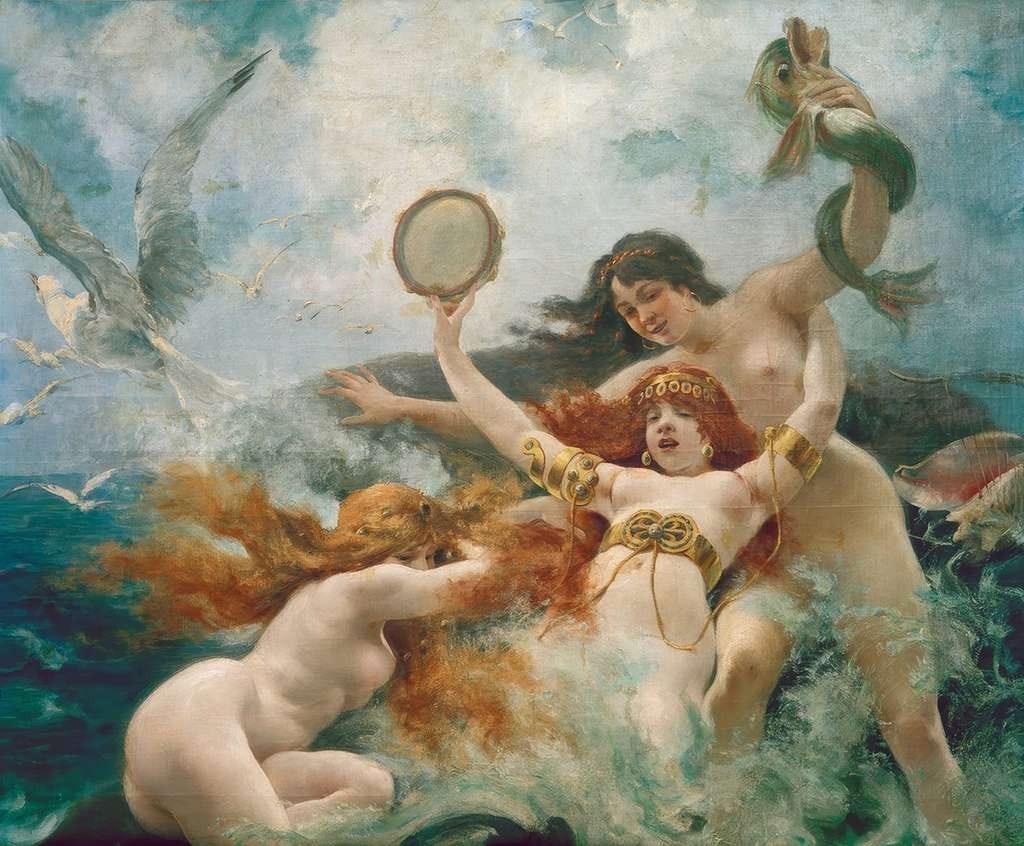
          The painting below, by a French academic, Adolfe Le Lyre, and called “The Sirens Amuse Themselves,” was somehow included in Google’s page of Images when I sought illustrations of the Caduceus: the women’s bare bodies, arms open wide, spread like the wings of that token seagull who's taking terrified flight from their joyous hullabaloo, the fish twined around the raised arm of the darkhaired one, her other arm sustaining her balance on an obscure, brine and foam-lashed black rock, the redhead on the bottom of this naked tableau’s in possible imitation of Hermes’ Caduceus. She has her eyes closed because of exhaustion, or is simply overwhelmed by satified complacency at her fortunate inclusion in this joyously amused sisterhood. The tambourine waved by the woman in the middle chimed for me with the firecat’s leaping and bristling in ineffectual, fruitless irritation with the clattering bucks, a connection certainly never intended by the artist, the women’s very nakedness reflecting the firecat's aspirations, which Stevens’ pokerfaced little prelude of a poem mocks. I chose the painting, of course, to attract startled attention and raise complementary  consciousness.
THE SIRENS AMUSE THEMSELVES ~ ADOLFE LE LYRE


EARTHY ANECDOTE

Every time the bucks went clattering
Over Oklahoma
A firecat bristled in the way.

Wherever they went,
They went clattering,
Until they swerved,
In a swift, circular line,
To the right,
Because of the firecat.

Or until they swerved,
In a swift, circular line,
To the left,
Because of the firecat.

The bucks clattered.
The firecat went leaping,
To the right, to the left,
And
Bristled in the way.

Later, the firecat closed his bright eyes
And slept.
                              WALLACE STEVENS
For many years, I found reading “Earthy Anecdote”—it opens HARMONIUM, Stevens’ first published book, and remains at the very beginning of his COLLECTED POEMS—oppressively uninviting, vacuous, disappointing, faintly dingbat and arbitrary, repetitious, stupidly-stubbornly occluded, mildly silly at my expense, which I think is often the early impression of Stevens many readers suffer. Nobody taught or touted him at my college, Penn State, and I didn’t understand, in those days, the need to locate the rhetorical motive which gives utterance coherence. ‘Every time’ has a bedtime or once upon a time flavor. It’s calming, faintly teasing, as if the reader were one more obstreperous buck or child requiring their routine soporific to put childhood’s clattering aside for the night. Then Oklahoma slips in other issues, being where, 80 pages, “Life is Motion,” Stevens’ only other mention of Oklahoma ever is where those Buffalo Gals, Bonnie and Josie, are caught Dancing around a stump—ah, Bacchae, dancing around the stump of what's left of Pentheus's head, yanked off by his Mom, who's joined the dance, for his spying on the naked women's unified ecstasy—my guess is from the window of a passenger train, Hartford Accident and Indemnity having put him in charge of their new livestock division, obliging him to crisscross the the southwestern range by train—they're as if in the buff, their burning bushes effecting splintery deltas such as Moses insisted the Israelites follow by night for 30 years in the wilderness, such as Shakespeare's waste of shame, as he deemed lust in action (Sonnet #129).
These happily deranged, fledgling Oklahoma euberants are garbed in either snug or overwashed, loosely fitting Calico dresses, implicitly provoking, if one is adequately agitated and brought to a pacified, yet susceptible a state of mind by this tiny stanza of a poem’s final line, Celebrating the marriage of flesh and air. “Earthy Anecdote," paired with this titillating bit of excitement was republished in the avant-garde poetry magazine, OTHERS, at that point edited by William Carlos Williams in final year of its existance.
“Earthy Anecdote” immediately hypnotic with A firecat bristled in the way. What’s a firecat? Bucks are male, clattering is their obnoxious noise. The bucks are evidently subdued, but certainly not stampeding as they would if the firecat were a coal burning steam locomotive. Yet I think of a stanza Leadbelly’s cheerful “Titanic”—Jack Johnson tried to get onboard/Captain he said I ain’t hauling no coal/Fair thee, Titanic, fair the well!
The behavior of the bucks is mind-twisting. They’re not terrified. They haven't stopped clattering/Until they swerved in a swift, circular line,/Because of the firecat, simply shifted direction, they’re swift, circular swerve a line-dance mocking the firecat’s solitary and exhausting leaping and bristling, a crafty, defiant, communal political gesture, savagely erotic, doing a dance that entrances such as Ma Rainey sang about Black Bottom, the dance originating either in Africa or the Deep South that displaced the Charleston as a hand, knee, buttock and bosom, jug-band, ragtime, boogie-woogie and display of Black disregard for silly, white, puritanic, comically repressed horrification. If Stevens were under the tent a watching a show, his eyes would have been blinking rapidly, or open wide as his nose and not blinking at all. If I don't know for sure what's it's because I’m not supposed to know. Inside “Earthy Anecdote’s” flat, unemphatic reportage, succinct yet vatic incantation, lulling as a lullaby, these seemingly self-segregated clattering bucksswerving in swift circular lines/To the right and to the left, function like windshield wipers in a Florida downpour to wiped the white mind’s slate clean.
Bucks are male, a pejorative for young Black males. Anecdotes are privileged pieces of unpublished, illustrative gossip, most intriguing when injurious, ot at leasst humorous. The firecat is now gendered male. Besides Giant in adulthood, Red was the nickname Stevens endured in his youth. Of course for me he’s the firecat of this allegorical fabliau, feline since afire, the poem the howl of a bloodhound who has the scent of pheromone going straight from nose to brain. He’s also the sun, we might insist, who rises to steadily leap and bristle, and then later slept. Hercules dies thanks thanks to the centaur who’d raped his latest beloved, but survived long enough poison the lining of the hero’s lionskin cloak with his blood.
In any case, he's not a redhead’s rufous muff or bush, nor to be conflated with hillbilly Bonnie and Josie of “Life Is Motion,’ firecats of a different order and gender. The conclusion of “Earthy Anecdote” is not a climax. It’s an anticlimax, and when I calmly and unirritated accepted this, is realized, that like so many fabliau of the frustrated cherchez la femme variety, was a shaggy-dog story—some little old lady speaking through the crack left by her door’s safety chain, who’d promised a cash reward for the return of her ‘shaggy dog,’ tells the overly hopeful hobo holding one such canine in his arms, ‘Oh no, my dog wasn’t that shaggy!’ A tale with a wagging tail, and faintly blue. As for convulsions of jealousy, a well-paid emerata professor at the University of Toronto asserts, as if intuitively suspicious, in her READER’S GUIDE WALLACE STEVENS, that by Earthy Stevens means of the earth, rather than gross, and a late, revered Stevens expert at Harvard, also a retired emerata, declared, coming closer to the mark, A manifesto, but of what? How about, You snooze, you lose!
And that’s exactly, and inexactly, what a prelude or overture could be, a declaration of themes and means. But after all, the Toronto emerata's book provided me with the information that “Earthy Anecdote” was published along with “Life Is Motion” in OTHERS, the avant-garde poetry magazine, in 1919, a year after its very first publication in THE MODERN SCHOOL 5, in 1918.
I’ve no idea how Stevens hooked up with THE MODERN SCHOOL, a largely leftwing, immigrant commune established by philosophic anarchists on farmland purchased in New Jersey following the accidental explosion of homemade bomb in the group’s former headquarters in New York City, the anarchists needing to distance themselves from complications which ensued from its founders, Emma Goldman and Alexander Berkman’s revolutionary enterprises, which besides this homemade bomb’s premature explosion, included Berkman’s attempt to assassinate steel magnate Henry Clay Frick for his role in the Homestead Strike Massacre. Stevens was no anarchist, rather an upwardly mobile Republican who despised FDR, but ones life, background, personal adversities inevitably complicates things.
As for "The Paltry Nude Starts on a Spring Voyage," a scullion, the lowest menial station of a kitchen worker, so maybe a dishwasher at the Casa Marina where Stevens' stayed for on his February spring in Key West visits, year after year, this one has scrubbed the fate Stevens had in mind for her, by irretrievably taking herself Across the spick torrent, or the Gulf Stream, though far as I know nobody says so or touches with a ten-foot pole, preferring spick to mean totally clean as in spick and span, taking herself on a briny path of her chosing toward the Bahamas and Cuba.
In all this, it helps to know, right off the bat, that a harmonium, which lent its name to Stevens’ first collection, is a pump organ relying on air from a foot or hand-pumped billows to make music as the air is forced over reeds, of common usage in farm-country churches, so a self-mocking choice by Stevens in his late 30s, 40 when actually published. He seriously considered calling his COLLECTED POEMS, him now in his early 70s, THE WHOLE OF HARMONIUM. At its best, a harmonium is something like an upright piano, foot-pumped for air. At its worst it’s a box the size and shape of a suitcase with a keyboard for one hand, hand-pumped billows for the other. They’re larger and less whiny than accordions, but afforded rural church Sundays a gratefully pious replica of tone and accompaniment for hymn singing. As a title, HARMONIUM slyly more comically redneck than celestial, harmonious orspiritual, or celestial, with less to do with cosmic harmony, the divine array of heaven’s stars, or the riddles of higher spiritual truth, which is I sought when I first turned to Stevens' poetry.
Oklahoma is and was the Sooner state, a nickname which evokes amorous urgency and premature jumping of the gun to attain earthy possession and hormonal agony’s relief. When Bonnie and Josie/Danced around a stump/(and) cried/”Ohoyaho/Ohoo
. . . (they were) Celebrating the marriage/Of flesh and air.
They were dressed in calico, flour sacks imprinted with dotted lines for cutting and conversion into dresses, so I can’t insist they were naked except in a viewer’s mind, what with their cries echoing Ahoy! (You’re welcome aboard the sip!), and O who? ignorance proverbial bliss, its excitement obliterating memory of line 3, as I’ve let it at times do for me.
*
Stevens’ firecat may well have been a railroad locomotive intimidating a herd of frantic antelope, the clattering bucks poetic rivals, percieved mediocrities, or also those chuckleheads Yeats called ‘Poets of the Cheddar Cheese,’ poet-tasters whose work was noisy shuck and jive, but even more pointedly, the firecat’s male rivals, his opening three poems and possibly more, examples of male courtship and display: “Earthy Anecdote” free verse, “Invective against Swans,” irregularly rhymed couplets in iambic pentameter, and “In the Carolinas,” a poetic dialogue with last year’s lover, him Harvard, the woman in the unapologetic poetry of her people. Here’s a taste of how she whose aspic nipples for once vent honey responds to the white man's taunting, eplaining herself in a folk poem's succinctness:The pine-tree sweetens my body and with no punctuation affirms to soothe him, The white iris beautifies me (no punctuation for folk poetry except mine).
	The white iris, dismayed to discover aspic nipples to be a lady with a baby, is in my view the same self-alienated, despondent fellow offering a 3rd person inventory in the immediately preceding poem “Invective against Swans,” and whose speaker, I wish to insist,  allies himself and with those those crows (that) anoint the statues with their dirt, though misery unrelieved by scrawling a listless testament/Of golden quirks and Paphian caricatures. Paphos, at the southern bottom of Cyprus, is to this day a circus of a city, something like Atlantic City, New Jersey or Orlando, Florida, was once the ancient Greek equivalent of Rome’s Pompeii and Kubla Khan’s Xanadu, though unlike Pompeii and Xanadu not demolished, by volcanic indignation.
	As for “Earthy Anecdote,” note how the rampant firecat, with all his confident but exhausting, heraldic and erect leaping and bristling, is quite ridiculous, how the clattering bucks, far from fleeing his territorial menaces, swerved/In a swift, circular line, and To the right/to the left, those sparring positional political credulities of democracy’s fervent, barely consequential, abidingly pious voting public—all mockery, including the muted, bedtime story placidity of Every time, the trope which initiates this prologue, overture and introduction of themes and means.
        This triptych of what I seem to be calling formalist-minded, male poetic display, seems to conclude with “The Paltry Nude Starts on a Spring Voyage,” (Botticelli's "Birth of Venus,") and yet not, since this goddess where she goes/ (looking for the tumultuous brine’s whirlpool of the senses)/In the circle of her traverse of the sea, and continues with “The Plot against the Giant” perhaps concluding—but not so much, with “The Snow Man,” and the mind of winter. I’d hate to omit attention to the bland motions (back at "Invective against Swans," of cheesy poets, and all other rivals, now that we've suffered by the firecat's light, along with Stevens' the swanning by swerving of those clattering bucks)  my favorite Giant consigns, or as he says, donates (them) to the air.
	I don’t believe, as I’ve muttered again and again, that Stevens left Harvard after his 3rd year because he was a “special  student.” I think he was expelled for not fitting the Harvard mold, observed by a professor sitting at the back of a Cambridge ice-cream parlor, climbing over a counter and proposing marriage to a middle-aged waitress selling scoops of frozen concupiscent custards. I may be wrong. I too have been scorned, ignored, erased—alarming resentful departmental colleagues in a sturdily mediocre institution for 40 years, who shielded themselves and expelled, rejected and abandoned me for not fitting their molds. Many are the rugs pulled from under us in love and life, and of course, finally, death's filthy cerement.
        What we know consists of dots like stars in the sky, and we connect them as best we can on the basis of who we are. But we know, some of us, what the girl by the whirlpool/Looking for a new fool is indubitably up to thanks to Bob Dylan. Lots of people adore this poem, and I agree. I think with amazing concision, and with the benefit of my explication, “Earthy Anecdote” is rich and beautiful, and reveals diamond-bright and razor-sharp facets of Stevens that have been cautiously intimated, but have generally escaped academic attention.
[What's that kid doing in my childhood's patched clothes? There'll be three more installments of PERSONAL POETIC #4, unless all this bombs.]
Thanks for reading! Subscribe for free to receive new posts and support my work.
What stayed with me most is the way you turn reading into a personal experience rather than an exercise in interpretation. Even when I don’t agree with every turn, I find myself wanting to follow the movement of the thinking more than arrive at a conclusion.


What stayed with me most is the way you turn reading into a personal experience rather than an exercise in interpretation. Even when I don’t agree with every turn, I find myself wanting to follow the movement of the thinking more than arrive at a conclusion.